The EdgeIO Controller is an industrial‑grade edge I/O module developed by Beilai Technology, featuring edge computing, flexible configuration, and native MQTT cloud connectivity.
More Than Just I/O – A Controller with Built‑In Edge Computing Power
The EdgeIO Controller is an industrial‑grade edge I/O module developed by Beilai Technology, featuring edge computing, flexible configuration, and native MQTT cloud connectivity.
Compared with ordinary I/O modules, it offers fundamental improvements in networking, protocols, functionality, scalability, and remote maintenance.
In short: Ordinary I/O is just a signal channel – BL192 is an intelligent edge node with “built‑in computing power + direct cloud connection + mixed I/O expansion”.
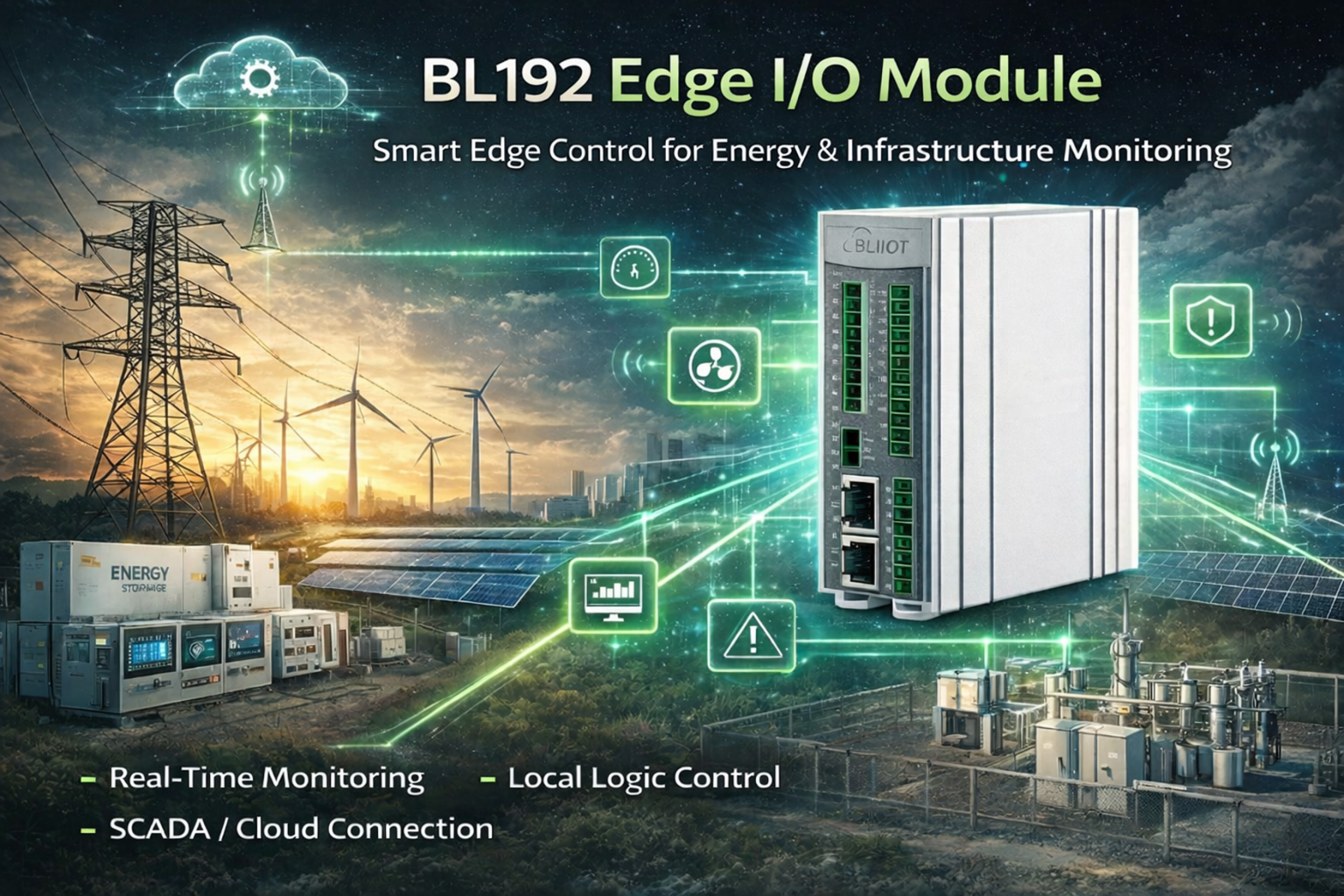
The following six typical application scenarios best demonstrate the cost‑effectiveness and practical value of the BL192 over ordinary I/O modules.
1. Lightweight Automation Without a PLC
Applications
Small machine control, stand‑alone automation, simple interlocking / alarm control.
Why choose BL192?
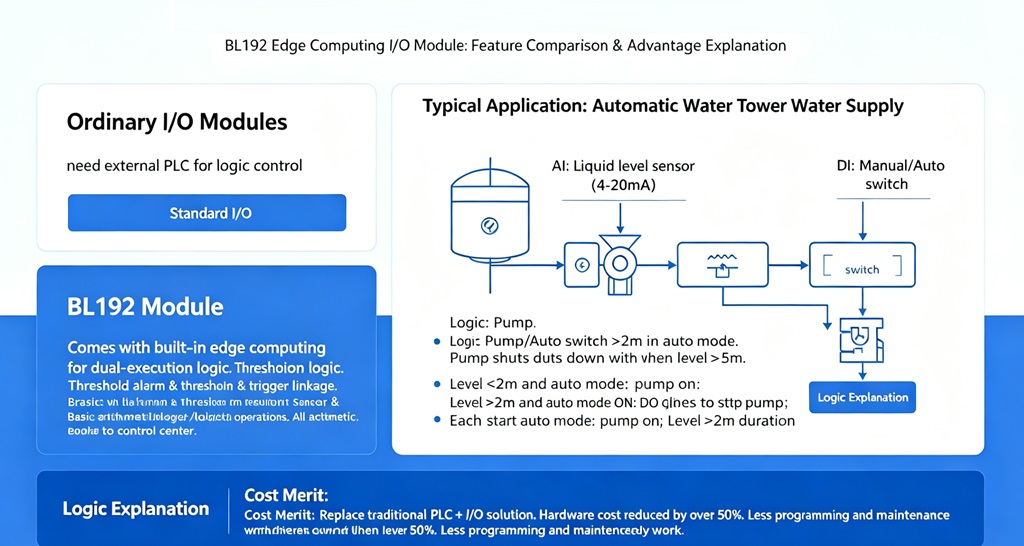
Ordinary I/O modules must rely on an external PLC to implement logic control. The BL192 has built‑in edge computing power and can execute locally:
-
Interlocking between sensor signals (DI/AI) and actuators (DO/AO)
-
Threshold alarms and conditional triggers
-
Basic arithmetic / logic operations
Typical logic example
Automatic water tower refilling control
Connect a level sensor (4‑20mA) to an AI channel, and a manual/auto selector switch to a DI channel.
Logic: When the liquid level < 2m AND auto mode is ON, close DO to start the pump; when the liquid level > 5m, open DO to stop the pump.
At the same time, every start/stop action is reported to the cloud via MQTT to record running time.
Cost‑effectiveness advantage
Replaces the traditional “PLC + ordinary I/O” combination, reducing hardware cost by more than 50% and eliminating PLC programming and maintenance effort.
2. Distributed IoT Data Acquisition & Cloud Upload
Applications
Remote equipment monitoring, environmental monitoring, energy data collection, smart factory data acquisition.
Why choose BL192?
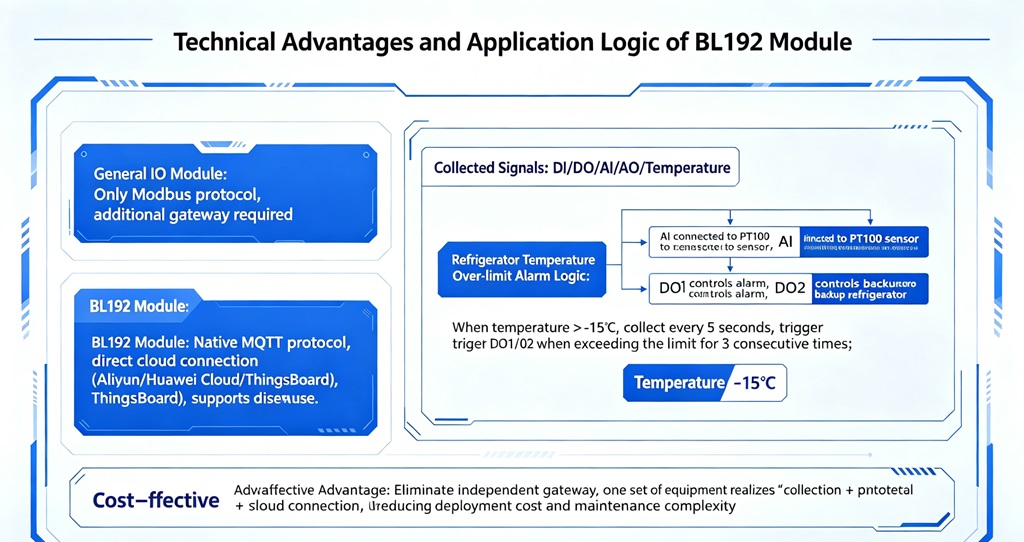
Ordinary I/O modules can only transmit data via Modbus and cannot connect directly to the cloud without an extra gateway. The BL192:
-
Natively supports MQTT protocol – direct connection to Alibaba Cloud, Huawei Cloud, ThingsBoard, etc.
-
Supports offline data buffering and retransmission – no data loss when the network recovers
-
Can acquire DI, DO, AI, AO, temperature and many other signal types – one device does it all
Typical logic example
Cold storage temperature alarm & local protection
Connect a PT100 temperature sensor to an AI channel, and a sound/light alarm plus a backup chiller to DO channels.
Logic: When the temperature > -15°C, sample every 5 seconds. If the limit is exceeded for three consecutive samples, DO1 starts the alarm and DO2 starts the backup chiller.
All temperature data and alarm events are sent to the cloud monitoring platform via MQTT in real time, with local caching during network outages.
Cost‑effectiveness advantage
Eliminates a separate gateway – one device does “acquisition + protocol conversion + cloud upload”, dramatically reducing deployment cost and maintenance complexity.
3. Mixed Signal Acquisition (Multiple I/O Types)
Applications
Projects requiring simultaneous acquisition of digital, analog, temperature, pulse, and other signals.
Why choose BL192?
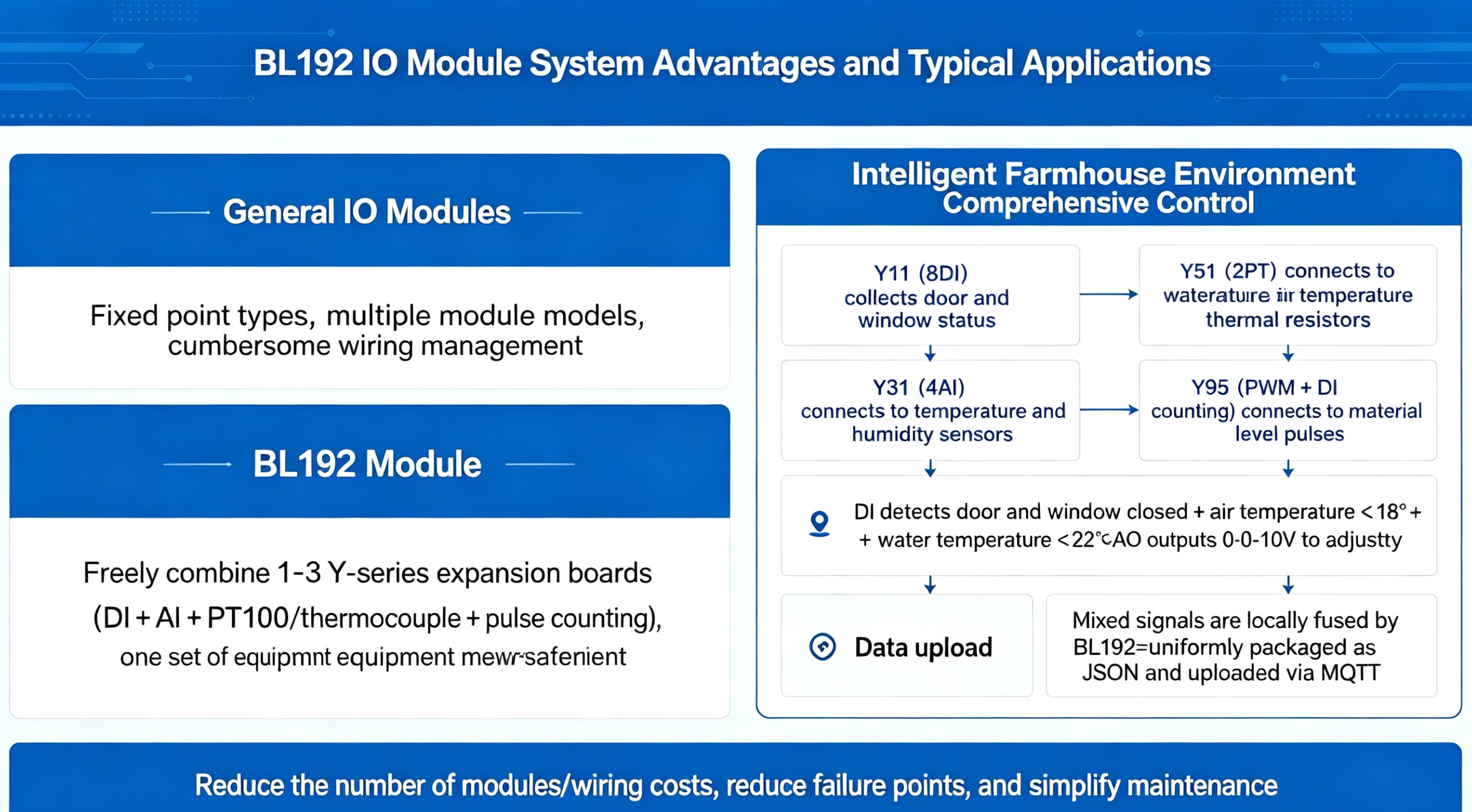
Ordinary I/O modules have fixed channel count and types – different signals require different module models, making wiring and management complicated. The BL192 supports:
-
Free combination of 1~3 Y‑series I/O expansion boards (e.g., DI + AI + PT100/thermocouple + pulse counter)
-
One device meeting multiple signal requirements – no extra expansion modules needed
Typical logic example
Smart livestock house environment control
Hardware combination: Y11 (8DI) for door/window status, Y31 (4AI) for temperature/humidity sensors, Y51 (2PT) for water and air temperature RTDs, Y95 (PWM + DI counter) for level pulse.
Logic: When DI detects doors/windows closed AND air temperature < 18°C AND water temperature < 22°C, AO outputs 0‑10V to adjust the heating valve opening. Meanwhile, the feed level pulse count accumulates the feeding amount, automatically resets daily and reports the total.
All mixed signals are locally fused by the BL192 and packed into a single JSON message sent via MQTT.
Cost‑effectiveness advantage
Reduces the number of modules and wiring cost, while lowering failure points from multiple devices – maintenance becomes simpler.
4. Remote Maintenance & Unattended Operation
Applications
Unattended pumping stations, remote telecom base stations, distributed energy sites, equipment monitoring in remote areas.
Why choose BL192?
Ordinary I/O modules cannot be configured or upgraded remotely – any problem requires an on‑site visit. The BL192 provides:
-
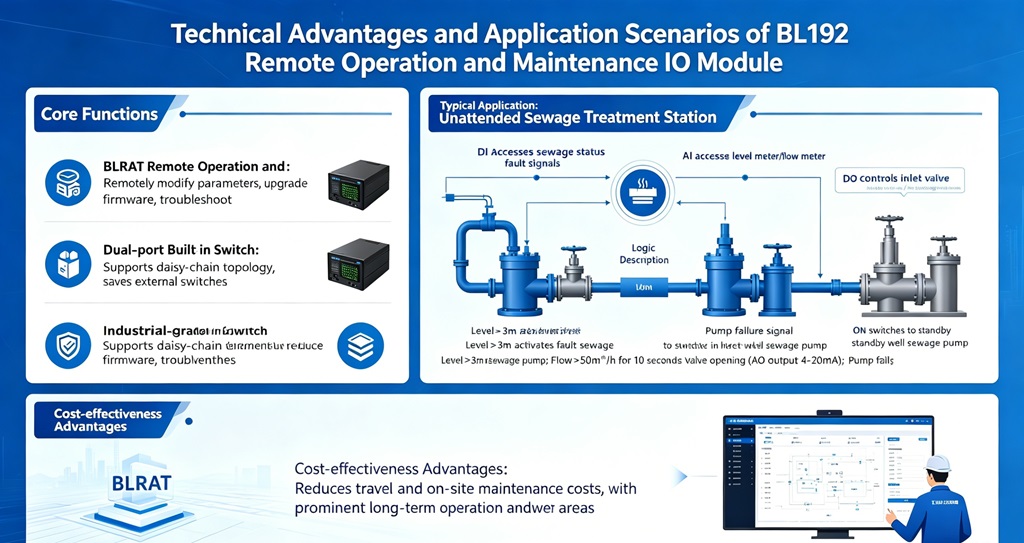
BLRAT remote maintenance tool – remote parameter change, firmware upgrade, fault diagnosis
-
Dual Ethernet ports with integrated switch – daisy‑chain topology saves external switches
-
Industrial wide‑temperature design (-40 to 85°C) – withstands harsh environments, reduces site visits
Typical logic example
Unattended sewage treatment station
DI for pump running status and fault signals, AI for level transmitter and flow meter, DO for inlet valve and sewage pump.
Logic: When the level > 3m, start the sewage pump. If instantaneous flow > 50m³/h for 10 consecutive seconds, reduce the inlet valve opening (via AO 4‑20mA). If the pump fault signal becomes ON, immediately switch to the standby pump and report the fault.
Engineers use BLRAT to remotely change the level threshold and flow parameters – no need to drive to the station.
Cost‑effectiveness advantage
Drastically reduces travel and on‑site maintenance costs – especially valuable for remote area projects where long‑term operational savings are significant.
5. Energy & Infrastructure Monitoring
Applications
Smart grid edge nodes, energy storage system monitoring, substation monitoring, street light / lighting system control.
Why choose BL192?
These scenarios typically require:
-
Simultaneous acquisition of voltage, current, temperature, switch status, etc.
-
Local execution of simple control logic (e.g., over‑current protection, fault alarm)
-
Data upload to an energy management platform
The BL192’s edge computing + cloud connectivity perfectly matches these needs, while ordinary I/O modules cannot work independently.
Typical logic example
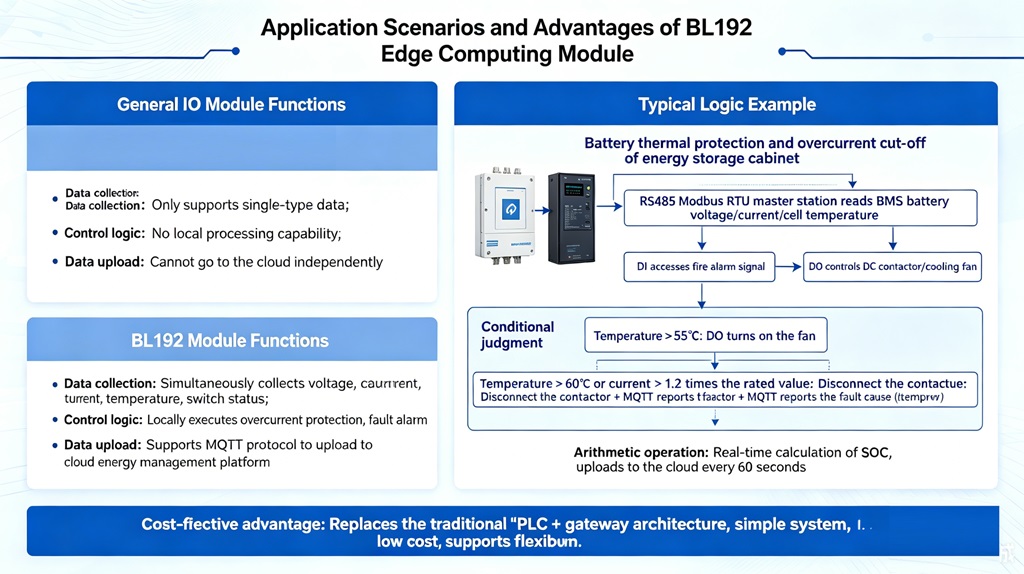
Battery thermal protection & over‑current cut‑off for an energy storage cabinet
Using the RS485 port as a Modbus RTU master to read battery voltage, current, and cell temperature from the BMS; DI for fire alarm signal; DO for DC contactor and cooling fan.
Logic: If any battery cell temperature > 55°C, DO turns on the fan. If temperature > 60°C OR current exceeds 1.2 times the rated value, immediately open the contactor and report the fault reason (over‑temperature / over‑current) to the cloud via MQTT.
At the same time, arithmetic operations calculate the State of Charge (SOC) in real time, uploaded to the cloud every 60 seconds.
Cost‑effectiveness advantage
Replaces the traditional “PLC + I/O + gateway” architecture – simpler system, lower cost, and supports future flexible expansion.
6. Building Automation & HVAC Control
Applications
Building lighting control, HVAC systems, elevator / pump interlocking, environmental temperature/humidity monitoring.
Why choose BL192?
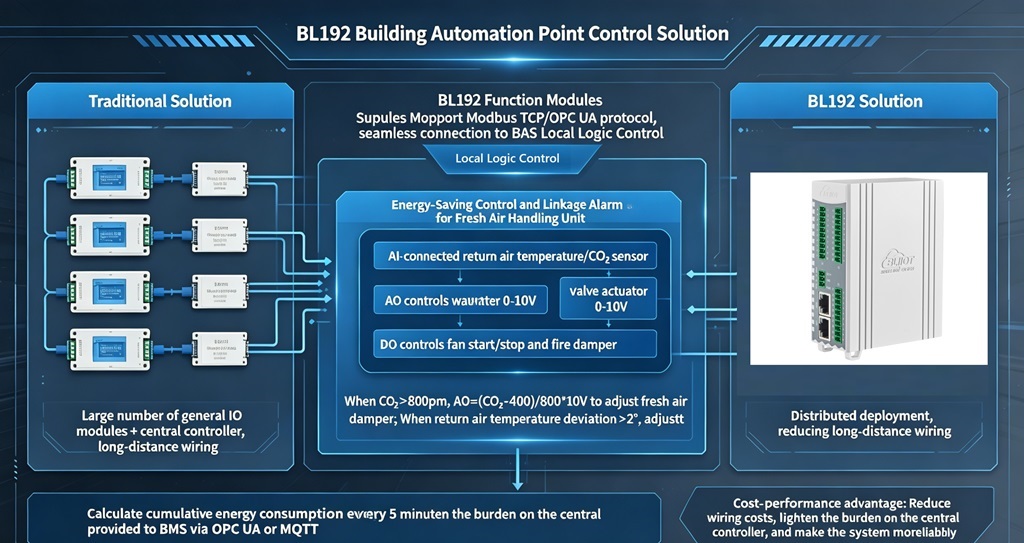
Building automation projects have distributed points and many signal types. Traditional solutions need many ordinary I/O modules plus a central controller. The BL192:
-
Can be deployed locally near each floor or equipment, greatly reducing long‑distance wiring
-
Supports Modbus TCP / OPC UA protocols – seamless integration with Building Automation Systems (BAS)
-
Built‑in logic control for local energy‑saving strategies
Typical logic example
AHU energy‑saving control & interlocked alarm
AI for return air temperature and CO₂ sensor; AO for water valve actuator 0‑10V; DO for fan start/stop and fire damper.
Logic: When CO₂ > 800ppm, output AO proportionally (CO₂‑400)/800*10V to adjust the fresh air damper. If the return air temperature deviates from the setpoint by more than 2°C, adjust the water valve first. When the DI fire damper trips, immediately stop the fan and report to BAS.
In addition, the BL192 calculates accumulated energy consumption every 5 minutes and makes it available to the building management system via OPC UA or MQTT.
Cost‑effectiveness advantage
Reduces wiring cost through distributed deployment, and reduces the load on the central controller – the system becomes more stable and reliable.
One Sentence Summary
If your project meets any two of the following criteria, the BL192 already offers far better value than ordinary I/O modules:
-
✅ Data needs to go to the cloud or connect to a cloud platform
-
✅ Local logic control / interlocked alarms are needed, and you want to avoid a PLC
-
✅ Signal types are complex – mixed I/O acquisition is required
-
✅ Equipment is distributed or located in remote areas – remote maintenance is a must
EdgeIO Controller BL192 – giving every I/O node edge intelligence.


